
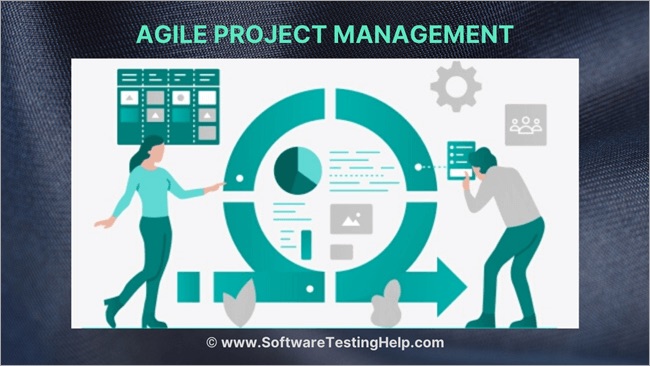
Below are some key points to note about the shift in mindset and working approach of project managers during Agile transformation:
Transition from developing and delivering products to developing and delivering value
Agile is a flexible, adaptive working approach focused on delivering customer value.
It is widely adopted across various industries—especially software development—to meet the fast-changing needs of markets and customers.
Agile helps increase efficiency, quality, and customer satisfaction while reducing risks, costs, and time to market.
To successfully implement Agile transformation, not only development teams but also project managers must shift their mindset and working methods to adapt to the new environment.
Project managers play a vital role in defining direction, shaping the product, and managing resources for the project.
They are also responsible for communicating and coordinating with stakeholders—such as customers, users, development teams, and other departments—to ensure products are developed and utilized effectively.
In Agile, a product is not merely a set of features and functions but a solution that delivers value to customers and the business.
Therefore, project managers should not only focus on completing and delivering products on schedule but also ensure that these products genuinely solve customer problems and create economic and social value.
To achieve this, project managers need to deeply understand customer needs and expectations, continuously gather and analyze feedback, and adapt products to optimize value.
They must maintain a strategic vision of the product—from ideation to end of use.
Example:
A project manager developing a dating app should not only focus on on-time, on-budget delivery but also on whether the app genuinely helps users find compatible partners, fosters meaningful connections, and retains users. They must research market trends, competitors, and user behaviors to design unique and impactful features.
Transition from measuring progress by outputs (product delivery) to measuring outcomes (value and impact)
In Agile, project progress is measured not by the number of features completed but by the value created for customers and the business.
Project managers must monitor not only traditional metrics like budget, time, quality, scope, and risk but also key performance indicators (KPIs) related to product value—such as user growth, conversion rates, revenue, operational costs, and customer satisfaction.
They should also establish SMART objectives (Specific, Measurable, Achievable, Relevant, Time-bound) for each stage and track results against expectations.
Example:
A project manager developing an e-commerce website should not only focus on delivery but also on whether it attracts and converts potential buyers, increases sales and profits, and reduces operational costs.
They should define KPIs such as site visits, bounce rate, conversion rate, and average order value, and set SMART goals like: within 3 months post-launch, increase traffic to 10,000/day, conversion rate to 5%, and revenue by 20%.
Transition from Project Management to Product Management
In Agile, the project manager’s role extends beyond product development to managing the entire product lifecycle.
This requires a strategic product vision—from ideation to end-of-life—and the ability to coordinate with all stakeholders to ensure effective development and utilization.
Project managers must also master Agile frameworks and tools like Scrum, Kanban, Lean, and Design Thinking.
Example:
A project manager for an educational app must focus not just on delivery but on whether the app truly enhances learning, drives engagement, and creates positive change.
They must track trends in the education market, identify new opportunities, and use tools like Scrum for sprints, Kanban for workflow tracking, Lean for eliminating waste, and Design Thinking for solving user problems.
Transition from developing what we have or are good at to developing what the market/customer needs that we can deliver
In Agile, product development should not be based solely on internal strengths but on customer needs and market demand.
Project managers must research and understand markets and customers to identify fitting and differentiating solutions.
They should test product hypotheses through Minimum Viable Products (MVPs) and gather feedback before scaling.
Flexibility is essential—discarding features or ideas that do not add value.
Example:
A travel app project manager should base development not only on existing data or partnerships but also on real customer insights—designing features like trip recommendations, booking tools, or chatbots to meet user needs.
If features fail to attract customers (e.g., experience-sharing or nearby-hotel suggestions), they must be ready to pivot.
Transition from focusing solely on organizational benefit to shared value for both customers and the organization
In Agile, a product is not just a revenue-generating tool but a solution that helps customers solve problems.
Hence, project managers must look beyond financial metrics to customer satisfaction and loyalty.
They must balance customer needs with organizational sustainability and cultivate an Agile culture that fosters collaboration, creativity, and continuous learning.
Example:
A project manager for a music app should not only focus on ad revenue or ticket sales but also on whether the app offers great listening experiences, builds communities, and respects artist rights.
Balancing user satisfaction with business sustainability may involve finding new revenue sources, reducing operational costs, or improving team efficiency.
They should also foster an Agile culture—conducting retrospectives to reflect, demos to gather feedback, and hackathons to explore innovation.
Conclusion
Project managers play a pivotal role in Agile transformation.
They must shift their mindset and approach—focusing on delivering value, measuring outcomes, managing product lifecycles, developing market-driven solutions, and creating mutual benefits for customers and the organization.
To succeed, project managers need a strategic product vision, customer and market insight, stakeholder collaboration, Agile competence, and a flexible, innovative, and learning mindset.
These are the key ingredients for project management success in the Agile Transformation Era.
Wishing all project managers success and fulfillment on their Agile journey!
